In today’s digital age, data plays a vital role in how businesses and organizations operate. To store, process, and analyze information efficiently, they rely on different types of database management systems. Among these, OLTP and OLAP stand out — two architectures designed for very different purposes. In this article, we’ll take a closer look at how OLTP and OLAP differ, and when each is most commonly used in business and industry.
- What is OLTP?
- Characteristics of OLTP Systems
- Advantages and Disadvantages of OLTP
- Examples of OLTP Databases
- What is OLAP?
- Characteristics of OLAP Systems
- Advantages and Disadvantages of OLAP
- Examples of OLAP Databases
- Differences Between OLTP and OLAP
- Choosing Between OLTP and OLAP
- Comparative Characteristics of OLTP and OLAP
- Comparison of Functions and Typical Operations
- Conclusion
What is OLTP?
OLTP (Online Transaction Processing) refers to a type of database system optimized for handling a large number of short, real-time transactions that support the daily operations of a business—such as purchases, orders, payments, and data updates. The key priorities of OLTP systems are high performance, data accuracy, and consistency under concurrent user activity.
Characteristics of OLTP Systems
- Main focus — speed and accuracy of operations. OLTP systems are designed to handle a large number of small transactions as quickly as possible. This includes order processing, customer profile updates, or inventory deductions. Response time is critical — often measured in fractions of a second.
- Works with current, “live” data. Unlike analytical warehouses, OLTP deals with real-time information: what is happening right now. Each change — whether a new record or an update — is immediately saved and made available to other users.
- High query frequency. OLTP systems handle thousands, sometimes millions, of queries daily. This is typical for e-commerce platforms, banks, delivery services, and booking systems.
- Normalized database structure. To avoid data duplication and ensure consistency, these systems use normalization — splitting information into logically related tables. This saves space and simplifies data updates.
- Small transaction size, but many operations. A single OLTP transaction typically involves a limited number of rows (e.g., placing one order), but the number of operations is massive. What matters is the system’s ability to handle flow, not the power of a single transaction.
- Support for ACID properties. OLTP systems strictly adhere to the four principles:
- Atomicity — all or nothing;
- Consistency — data always remains in a valid state;
- Isolation — parallel transactions don’t interfere with each other;
- Durability — data is preserved even in case of failures.
- Write load is higher than read load. Unlike analytics, which focuses on reading, OLTP is mostly about writing: INSERT, UPDATE, DELETE. This requires special architecture and DBMS configuration to ensure speed.
- Users — operators, clients, automated systems. OLTP is used in daily operations: a cashier enters a receipt, a client places an order, a terminal deducts funds. The system is operated by those involved in real-time processes.
- Time- and volume-limited reports. If analytical queries are needed, they are limited to simple requests — like “all orders today.” Complex analytics is not performed here — that’s OLAP’s job.
- Limited data history storage. OLTP systems generally do not keep long historical data. Old records are either archived or deleted to keep the system lightweight and fast.
- Sensitive to load and locking. As thousands of users may simultaneously update data, it’s crucial to properly configure isolation levels and indexes to avoid deadlocks and slowdowns.
- Focus on high availability and fault tolerance. Even short downtimes can cause losses. OLTP servers are often deployed with failover, replication, and other mechanisms to ensure uninterrupted operation.
Advantages and Disadvantages of OLTP
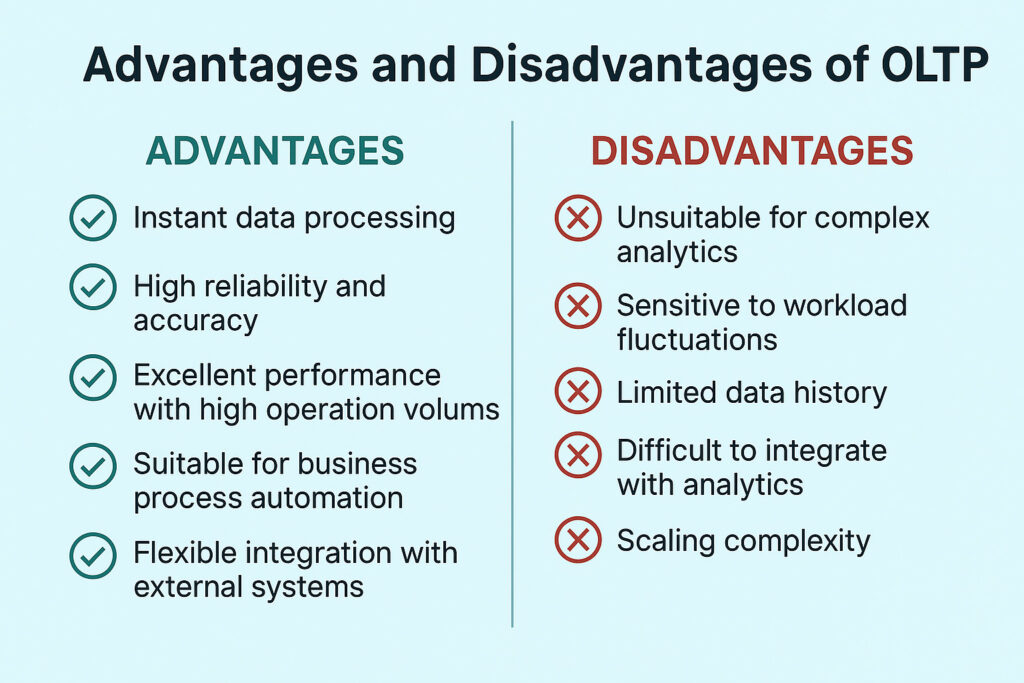
Online transaction processing (OLTP) has the following advantages:
- Instant data processing. OLTP systems handle routine operations lightning-fast. Payments, order placement, and profile updates all take fractions of a second. This speed makes them indispensable in e-commerce, banking, and booking services.
- High reliability and accuracy. Thanks to strict adherence to ACID principles, no transaction is “lost,” data remains consistent, and failures don’t corrupt the database. This is especially important in finance and resource management.
- Excellent performance with high operation volumes. OLTP systems can process thousands of requests per minute. Even when hundreds of users place orders or send requests simultaneously, the system remains stable and responsive.
- Memory savings through normalization. Storing data in normalized form prevents redundancy. This not only saves disk space but also simplifies updates — for example, updating client info in one place instead of dozens of tables.
- Suitable for business process automation. OLTP often serves as the “engine” for CRM systems, ERP, trading platforms, and other solutions requiring constant real-time interaction with users or devices.
- Flexible integration with external systems. These databases easily connect to APIs, payment gateways, mobile apps, and other external services, making OLTP a convenient core for ecosystems with various entry points.
OLTP also has some disadvantages:
- Instant data processing. OLTP systems handle routine operations lightning-fast. Payments, order placement, and profile updates all take fractions of a second. This speed makes them indispensable in e-commerce, banking, and booking services.
- High reliability and accuracy. Thanks to strict adherence to ACID principles, no transaction is “lost,” data remains consistent, and failures don’t corrupt the database. This is especially important in finance and resource management.
- Excellent performance with high operation volumes. OLTP systems can process thousands of requests per minute. Even when hundreds of users place orders or send requests simultaneously, the system remains stable and responsive.
- Memory savings through normalization. Storing data in normalized form prevents redundancy. This not only saves disk space but also simplifies updates — for example, updating client info in one place instead of dozens of tables.
- Suitable for business process automation. OLTP often serves as the “engine” for CRM systems, ERP, trading platforms, and other solutions requiring constant real-time interaction with users or devices.
- Flexible integration with external systems. These databases easily connect to APIs, payment gateways, mobile apps, and other external services, making OLTP a convenient core for ecosystems with various entry points.
Examples of OLTP Databases
In a world where the speed and stability of transactional operations are critical, certain systems stand out in popularity — including PostgreSQL, SQL Server, and Oracle. All of them are well-suited to heavy workloads and ensure reliable handling of live data.
- PostgreSQL — a freely distributed relational DBMS valued for its flexibility and extensive customization options. Thanks to its open architecture, it’s commonly chosen for projects of all sizes — from startups to large-scale platforms.
- SQL Server — a product by Microsoft recognized as a powerful transactional solution. Especially popular in business applications due to tight integration with other Microsoft services, high performance, and modern security features.
- Oracle — an enterprise-grade platform with a stellar reputation in the world of high-load systems. Known for its stability, scalability, and rich set of built-in features. Ideal for mission-critical tasks involving millions of transactions and high availability.
What is OLAP?
OLAP (Online Analytical Processing) is a database management system designed for analyzing large volumes of data. It is used for building reports, forecasting, trend analysis, and supporting decision-making processes. The primary focus is the speed of analytical queries, data aggregation, and multidimensional slicing.
Characteristics of OLAP Systems
- Focus on analyzing historical data, not real-time events. These systems are meant to explore what happened a week, a month, or even a year ago. They work with large sets of accumulated data rather than individual transactions.
- Data is gathered from multiple sources. Imagine data being consolidated from warehouses, sales departments, and accounting. OLAP collects, cleanses, and unifies it into a single repository, typically via ETL (Extract, Transform, Load) processes.
- Avoid complex joins — structures are simplified. Unlike traditional databases, OLAP minimizes relationships between tables. Data is organized using star or snowflake schemas to improve query performance and system efficiency.
- Data is treated as multidimensional cubes. OLAP analyzes information across multiple dimensions — for example, sales by time, region, and product category. This greatly helps analysts explore data from different angles.
- Little writing, lots of reading. OLAP systems are optimized for read-heavy workloads. Unlike transactional systems, they rarely perform bulk data modifications. The primary focus is on reading and analyzing data.
- Data updates are not urgent. There’s no need for real-time accuracy — updates might occur daily or weekly, depending on business needs. That’s acceptable for strategic analysis.
- Queries are complex but powerful. Retrieving meaningful insights often requires advanced SQL or specialized languages like MDX (for cubes) or DAX (in Power BI). These enable highly flexible and detailed analysis.
- Operations go beyond just “selecting columns.” Users can drill down (e.g., into time periods), roll up (aggregate by year), slice (filter by region), or pivot (swap rows and columns) — all within reports.
- Integration with BI systems. OLAP powers tools like Tableau, Qlik, and Power BI, which fetch the data, build dashboards, and visualize KPIs almost in real time.
- Massive data warehouses. We’re talking not gigabytes, but terabytes or more. These warehouses store years of data, often down to individual transactions or daily records.
- Users are strategists, not cashiers. OLAP isn’t used for routine daily tasks — it’s intended for analysts, marketers, and executives who need a full picture to make informed decisions.
- Data changes rarely, but meaningfully. Updates occur periodically. There’s no need for real-time changes — the priority is depth of analysis rather than immediacy.
- Flexible access control. For example, one user might see only their branches, another only certain metrics. OLAP handles this easily, with granular access controls.
Advantages and Disadvantages of OLAP
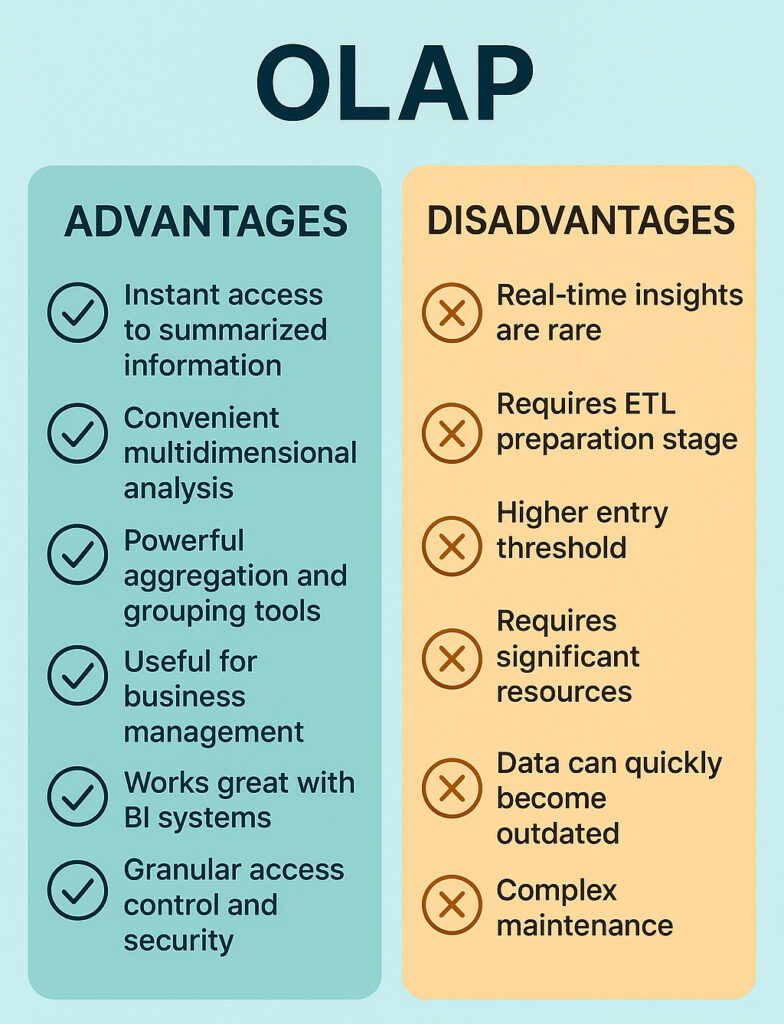
Online analytical processing (OLAP) offers the following advantages:
- Instant access to summarized information. One query — and you have a ready-made sales report for the past 3 years, broken down by region, product, and quarter. No need to filter Excel manually or wait for a CRM export.
- Convenient multidimensional analysis. OLAP lets you explore data from different angles — by time, category, region, or any other dimension. This “multidimensional” approach is valuable for discovering hidden patterns.
- Powerful aggregation and grouping tools. Whether calculating totals, monthly averages, or departmental maximums, OLAP handles it with ease and speed — even for terabytes of data.
- Useful for business management. Executives love OLAP for its ability to display key performance indicators (KPIs), compare current results with goals, and evaluate trends. It’s more than just numbers — it’s a decision-making tool.
- Works great with BI systems. OLAP integrates smoothly with Power BI, Tableau, QlikView, and other visualization tools. You can use it as a source to create beautiful dashboards and reports.
- Stable performance with big data. OLAP can handle massive datasets that would overwhelm traditional SQL databases, and it doesn’t require daily manual maintenance or optimization.
- Granular access control and analytics-level security. Access can be configured so that accountants see only their company, marketers only their category, and directors — everything. Convenient and secure.
OLAP also comes with a few disadvantages:
- Real-time insights are rare. If you need a report with data from the last 3 minutes — OLAP probably won’t help. Most systems update on a schedule (e.g., daily), which is fine for strategic analysis but not for real-time monitoring.
- Requires a separate ETL preparation stage. You can’t just “drop” raw data into OLAP and start analyzing. It must first be extracted, processed, and formatted — then loaded.
- This process takes time, resources, and patience. The entry threshold is higher than with simple SQL. Beginners might struggle — especially when dealing with cubes, MDX queries, or specialized functions.
- Requires significant resources. A quality OLAP server isn’t cheap — especially if you plan to store vast data volumes and serve hundreds of users. The infrastructure must be carefully designed.
- Data can quickly become outdated. In some industries, even data from an hour ago may lose relevance. OLAP is about “what happened over time,” not “what’s happening right now.” It’s not a flaw — it’s a design feature.
- Complex maintenance. With dozens of tables, complex relationships, and hundreds of reports — even a small change (like a new metric) might require restructuring the entire system.
Examples of OLAP Databases
When building analytical systems based on OLAP, modern cloud platforms optimized for storing and processing large datasets are increasingly chosen. Among the most prominent solutions are Snowflake, BigQuery, and Amazon Redshift — each with its own strengths and capabilities:
- Snowflake — a cloud platform known for its scalable multi-cluster architecture. It handles truly large volumes of data with ease, and its flexible resource configuration allows companies to tailor the system to their needs.
- Amazon Redshift — a fully managed data warehouse by Amazon. It is ideal for running complex analytical queries on massive datasets and is widely used in enterprise analytics environments.
- BigQuery — a Google product known for high scalability and serverless infrastructure. With built-in machine learning support, it’s a great choice for organizations that need fast insights from large volumes of data.
Differences Between OLTP and OLAP
Although both OLTP and OLAP play vital roles in building a complete data architecture, each is designed for different tasks and scenarios. They don’t compete — they complement each other: one ensures the stable functioning of daily operations, while the other provides tools for analysis and decision-making.
Choosing Between OLTP and OLAP
When choosing between OLTP and OLAP, it’s essential to focus on the actual needs of your business. If the primary workload involves frequent but small transactions — such as order processing, user data updates, or in-app event logging — then OLTP is the ideal solution. These systems are built for speed and real-time stability, which is why they are widely used in banks, stores, reservation systems, and other industries where fast response and data freshness are critical.
On the other hand, if your goal is to analyze accumulated information, generate reports, identify trends, and discover correlations — then OLAP is the better choice. These solutions are optimized for reading large datasets and are ideal for reporting, dashboards, and business intelligence. Thanks to their specialized architecture (such as denormalized storage), OLAP systems handle complex queries quickly — even when working with terabytes of data.
It’s also worth noting that in real-world scenarios, both approaches are often used together. This hybrid model enables real-time processing of data in OLTP systems, followed by subsequent analysis in OLAP systems. It helps businesses react quickly while also making thoughtful strategic decisions. Ultimately, the right choice depends on the nature of your data and the tasks at hand. A solid understanding of the differences between OLTP and OLAP will help you build the most effective architecture to support business growth and streamline decision-making.
Comparative Characteristics of OLTP and OLAP
| Characteristic | OLTP | OLAP |
|---|---|---|
| Type of processing | Transactional | Analytical |
| Users | Operators, cashiers, clerks | Analysts, executives, managers |
| Number of records | Usually small (within one transaction) | Millions or billions of records processed |
| Operation frequency | Very high | Medium / low |
| Data volume | Gigabytes | Terabytes and beyond |
| Data source | Operational DB | Data integrated from multiple sources |
| Data freshness | Current (real-time) | Historical (may not be up to date) |
| Normalization | High (3NF and above) | Denormalized (star, snowflake) |
| Goal | Automation of business processes | Decision-making support |
| Structure | Tabular, normalized | Cubical, hierarchical |
| Query complexity | Simple queries (SELECT, INSERT, UPDATE) | Complex queries (JOIN, GROUP BY, WITH ROLLUP) |
Comparison of Functions and Typical Operations
| System | Main Functions | Example Operations |
|---|---|---|
| OLTP | Registration, modification, and deletion of data | INSERT, UPDATE, DELETE, SELECT |
| OLAP | Multidimensional analysis, aggregation, report generation | GROUP BY, JOIN, ROLLUP, CUBE, WITH (CTE), analytical functions |
Conclusion
In conclusion, OLTP and OLAP represent two distinct approaches to working with data, each tailored to its own purpose. OLTP systems are indispensable where fast processing of daily transactions is essential — such as in e-commerce platforms, banks, or delivery services. At the same time, OLAP systems allow businesses to analyze accumulated data, generate reports, identify trends, and make informed business decisions.
A clear understanding of the differences between these two types of systems not only helps to avoid mistakes when designing data architecture but also enables the development of an efficient and sustainable information strategy. When choosing a solution, focus on your real business needs — and your data management system will become not just a technical foundation but a true tool for growth and development.